
Learn the truth behind LCD technology and image persistence
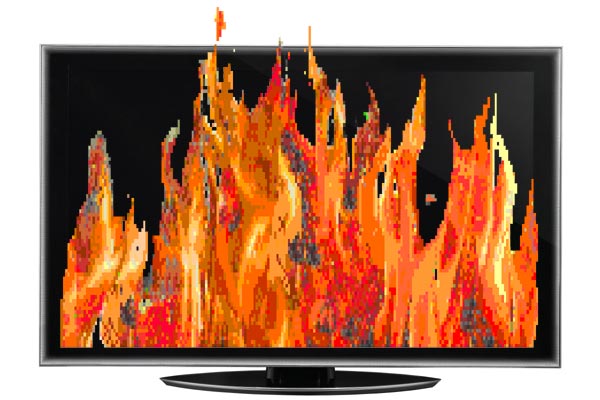
What Is Burn In?
Burn in is one of the most commonly misunderstood concepts in regards to modern television displays. "Burn in" is a phenomenon associated to television products, in which a static image left on the screen, over time, can permanently wear itself into the display. This issue is generally associated to phosphor based television displays like tubes, CRT rear projection, and plasma displays.
A common question asked is if alternate, non phosphor based television products, such as LCD and DLP televisions, are susceptible to burn in. The most common answer given to this question is no, LCD amd DLP televisions are immune to burn in.
It's generally accepted that DLP TVs are generally immune to burn in. For LCDs, however, immunity is somewhat of a half-truth.
The Truth About LCD and Burn In
It is a fact that LCD displays are immune to phosphor wear, simply because LCD televisions do not use phosphor to create a television image. Otherwise, it would be like saying an electric car can run out of gas. That does not mean LCD displays are immune to the effects of static images. On LCD displays, this is kindly referred to as "video memory" or "image retention."
LCD panels use a complicated process of organizing liquid crystal molecules into a twisted or untwisted state, which allows polarized light to pass through the liquid crystal substrate. Over time, it is possible these liquid crystals can "get used to" the state of twist they are in, causing a static image, very similar to phosphor burn-in, to be visible on the screen permanently.
[[ad]]
Some say that simply turning off the display for 24-48 hours eliminates this effect, while others have claimed the effect is permanent in extreme cases. Nonetheless, home users of LCD televisions have generally little to fear.
Why Video Memory Is Little Concern To LCD TVs
The nature of LCD products makes them extremely resilient to building up a video memory. In fact, you're far more likely to see this issue on LCD computer monitors. If, for example, the Windows or Macintosh desktop was left uninterrupted on a LCD display, with no screen saver for an extremely long period of time, image persistence could become an issue and (possibly) be permanent.
LCD televisions, on the other hand, typically get enough image movement or power cycles that the buildup of video memory is highly unlikely, although not impossible for those who love channels like CNN. Leaving static images on an LCD display for a relatively short period of time will have no damaging effect to the display.
In other words, you'll only get video memory buildup on an LCD television if you either try to do it on purpose or step well outside the norm when viewing static images.
What's outside the norm? Viewing a large amount of 4:3 programming on a widescreen display with static bars on the side can, as community members have pointed out in the comments area below, increase your risk of video memory or image persistence... even on LCD displays. While I still don't find it 'likely' that this commonly occurs, it's always prudent to limit viewing of static images whenever possible, so do yourself a favor and take advantage of the various formatting modes your television provides.
In recent times, TVs are shipping with a vast number of smart features to do things like playback media from a NAS device or stream content from the web. These displays spend a much greater period of time in menus with static elements than the TVs of yore; the likelyhook of seeing issues with image retention on LCD TVs are increasing. Smart TV owners need to be increasingly cautious regarding how long static images (like a TVs audio player) remain on the screen.
Better To Be Safe Than Sorry
There isn't a huge need for the typical television watcher to concern themselves with video memory and image persistence on LCD televisions; it's not likely under normal viewing conditions. Still, it never hurts to be safe than sorry. Follow these tips to ensure a video-memory-free experience with your LCD TV:
- Limit your viewing of 4:3 material on widescreen TV with static bars. Use the formatting modes on your TV to reformat 4:3 material to fit the 16:9 screen. Also, don't watch 1000 2.35:1 ratio DVD or Blu-Ray movies in a row.
- Be careful of channels that maintain a static, never moving, logo somewhere on the screen.
- Be careful when playing video games that contain a static graphics, like a life meter or HUD. Make sure you vary your gaming or watch other things between gaming sessions.
- Be careful of channels with stock tickers and other non-moving images
- Be cautious of media features and menus in smart TVs.
[Updated from original version; re-phrased to make it clear that while video memory is unlikely, it's not impossible. Thanks to WA6ATI for his comments.]
[Rewritten on May 6th, 2011. Originally published on December 14, 2004 at 9:13 AM]



Comments
Sorry to say that burn-in is
Sorry to say that burn-in is alive and well for LCD TVs. My Toshiba has thin dark lines where the black bars are aligned on each side of the screen, obviously from the times when there is no HD signal present. The lines are exactly where the normal screen width is located.
The lines only show up when an HD scene is showing a light blue, gray or sandy color. It's like someone has drawn thin lines where the black border ends and the picture begins on a normal 4:3 legacy picture. We only view legacy 4:3 pictures when the originating signal is is not broadcast in HD, usually around 50% of our viewing.
Toshiba service center is currently looking at it for repair under warranty.
Respectfully, I do not agree
Respectfully, I do not agree with Matt Whitlock’s final statement, There is no need for the television user to concern themselves with video memory because it's just not possible under normal viewing conditions.
I guess the operative word to consider here is "normal". What is normal? Not one vendor has stepped up and defined this variable. I have been in the service business for over 42 years and I have seen everything. What is normal in a lab environment is not the same, as John Q. Public understands it. We have seen hundreds of these LCD panels with this Image Persistence symptom so sever the panels require replacement.
This is nowhere near the tens of thousands of Projection TV CRTS, or Plasma TV's with image burn in. But to say that it is not possible for the LCD to have Image Persistence caused by a static graphical image, or running the set in the 4X3 mode for more than 50% of the time is unreasonable. It does happen and the consumer needs to be educated on how to prevent this.
Avoid static, stationary images on the screen d\for long periods of time.
Avoid running the TV in the 4X3 mode for more than 10% of the time.
Complain to your cable provider and broadcast stations to either move, eliminate, or otherwise alter their Logo that stays on the screen all the time.
Yes even these innocent logos from your friendly TV station, or Q V C Pricing logo have cost customers millions of $$ because of these logo burns.
As far as I know DLP was completely immune to Image Persistence or burn in.
Dennis
http://wa6ati.com
WA6ATI said:
After re-reading the artice (which I wrote a long time ago), it did come off as "it's impossible." While I still feel that this issue is highly unlikely, saying it's impossible simply wouldn't be true. I've updated and re-written sections to make it more accurate and useful to the reader thanks to your input.
Respectfully, I do not agree
Respectfully, I do not agree with Matt Whitlock’s final statement, There is no need for the television user to concern themselves with video memory because it's just not possible under normal viewing conditions.
I guess the operative word to consider here is "normal". What is normal? Not one vendor has stepped up and defined this variable. I have been in the service business for over 42 years and I have seen everything. What is normal in a lab environment is not the same, as John Q. Public understands it. We have seen hundreds of these LCD panels with this Image Persistence symptom so sever the panels require replacement.
This is nowhere near the tens of thousands of Projection TV CRTS, or Plasma TV's with image burn in. But to say that it is not possible for the LCD to have Image Persistence caused by a static graphical image, or running the set in the 4X3 mode for more than 50% of the time is unreasonable. It does happen and the consumer needs to be educated on how to prevent this.
Avoid static, stationary images on the screen d\for long periods of time.
Avoid running the TV in the 4X3 mode for more than 10% of the time.
Complain to your cable provider and broadcast stations to either move, eliminate, or otherwise alter their Logo that stays on the screen all the time.
Yes even these innocent logos from your friendly TV station, or Q V C Pricing logo have cost customers millions of $$ because of these logo burns.
As far as I know DLP was completely immune to Image Persistence or burn in.
Dennis
http://wa6ati.com
WA6ATI said:
After re-reading the artice (which I wrote a long time ago), it did come off as "it's impossible." While I still feel that this issue is highly unlikely, saying it's impossible simply wouldn't be true. I've updated and re-written sections to make it more accurate and useful to the reader thanks to your input.
I'm horribly disappointed now
I'm horribly disappointed now knowing the "possible" problem of "burn in" with LCD TVs. There's a tremendous amount of 4:3 programming out there, and some of us don't like the "fat faces" one gets stretching the width of the image, or the cutoff of the top and bottom one gets in zoom mode. Given the scarcity and added expense of HD programming, this is unacceptable.
Rather than saying that image burn is not covered under warranty, like LG, the manufacturers could actually be proactive and do something about it. Maybe the manufacturers should vary the position of the 4:3 image left to right or up and down slowly, but continuously to avoid the static edges of the 4:3 image or letterbox bands for something not 16:9. I, for one, would not mind all that much that the side bars were uneven, or the letterbox bars were not the same size. Simple, simple programming, and a little ingenuity (and ownership of the problem) would be all it would take. Obviously, it is a problem the panel makers are trying desperately to hide.
My TV repair guy was puzzled
My TV repair guy was puzzled by the problem and said he had never seen it on any other TV before. He took it to a Toshiba repair center and they had to contact Toshiba. The official buzz word isn't burn-in. The new term for LCDs is persistance. They say it's temporary and to not let the 4:3 ratio pictures stay on the screen for a long time (did not specify what "long time" was). They also said they do not cover it under warranty, even though my warranty hadn't expired.
My experience is that it's not temporary although I don't notice it as much as I did before. Maybe because I know I just have to live with it.
The problem I have is that TV sales people use the no burn-in as a selling point when the manufacturers know there can be a problem - at least Toshiba knows.
I will never buy another Toshiba TV and I encourage those buying an LCD TV to stay away from Toshiba brand.
I sell TVs. I get so many
I sell TVs. I get so many people who see all of the negative things about Plasma who are simply misguided by our media. LCD definately gets burn-in.. I have a 46
My 46" Sanyo 1080p LCD had
My 46" Sanyo 1080p LCD had this, exactly where the 4:3 ration screen edge would have been: a vertical dark band to the right of the screen became apparent watching a DVD.
I am glad to day after about 6 weeks it has completely gone. Here's how.
1. lowered brightness, contrast and colour temperature to medium settings
2. ensuring we watched full-screen TV the while time
We didnt unplug it or anything, but the band DID eventually fade. Maybe we got lucky. I believe we caught it early. Now I have to watch the sports with the scores off-screen most of the time and CNN looks just plain wrong but what can you do. At least I dont have the marks any more. A $1600 TV is saved.
Carlo1,
Carlo1,
The thing I don't like is paying all of that money for a TV and it does not work as advertised. Changing the screen size and missing some of the display is something the manufacturers won't tell us we have to live with before we buy the TV.
I have since bought a Sanyo 42" LCD and have had no problems as of two months now. But I haven't noticed the lines as much on my Toshiba lately, I'm wondering if the new digital transmission has anything to do with that even though I get my signal through cable.
Maybe the TV manufacturers
Maybe the TV manufacturers could put some kind of screen saver on the black parts of the screen when in 4:3 or letterbox modes. If they just briefly turn on one pixel at a time in the black area, would that prevent burn-in?
My 42" Toshiba Regza 42HL167
My 42" Toshiba Regza 42HL167 has developed 4:3 screen burn. I call it "ghosting" because there are no dead pixels, just a haze exactly where the 4:3 lines would be. The lines are MOST noticeable in darker scenes on my Blu-Ray movies like the nighttime scenes at sea in Pirates of the Caribbean. I'm extremely aggravated but after 2 weeks of no 4:3 programming they seem to be fading. I'm gonna keep my fingers crossed but it doesn't hurt to email Toshiba about paying $1600 for a television a year ago and having this kind of problem when there is virtually no literature about it on LCD's (I had no idea this could happen and the salespeople told me it was "impossible".)
I told one of the salesguys at Best Buy about it when browsing for a new television last week and he pretty much called me a "liar" and assured me that it is "impossible".
Anyone who doesn't believe
Anyone who doesn't believe LCD TVs can have persistance needs to see this web page.
Email this link to your Best Buy guys and ask them when was the last time they designed an LCD TV because they seem to think they know more than anyone else, even the LCD manufacturers.
Living proof of lcd burn in
Living proof of lcd burn in http://albany.craigslist.org/ele/1506449023.html
Hello I have a 42 in Samsung
Hello I have a 42 in Samsung lcd TV that seems to have some sort o image in the middle of my screen. It almost looks like faint theatre drapes. As it comes down from the upper middle left side towards the middle lower right side on a diagonal slant. I have asked a few people and they are clueless.is there any way to rid the problem? Please help thanks.
The really frustrating thing
The really frustrating thing is that equipment manufacturers won't provide for grey bars on the sides of 4:3 content any more. I have Sony Bravia and Fios/Mot 6414 set top box. Sony doesn't provide grey bars because of the
I had a significant case of
I had a significant case of "burn -in" or "video memory" "pixel persistence"
on a Sanyo 32" LCD TV. I was getting ready to spring for a replacement when I read that a period of total inactivity might help it. Rather than let loose of $500, I did what others said works well in theory as well as in practice. I unplugged the monitor and the cables and let it sit for about 50 hours. I can still tell that it has been present with a dark gray screen. I had two, very annoying vertical strips in the viewing area. As others have reported, I had watched 4:3 pictures and had left discernible strips at the side but have discontinued this since I can bring them to fit the 16:9 screen without viewing the "squinched up" view you see others using on their sets. I'd rather cut some tops and bottoms off a screen so I use view choice 1 for that. I find that you have to do this on a lot of 16:9 screens if there are subtitles since Hollywood has not "aught on"yet. Typically the "start screen," even on a widescreen film, is so that you have to use the 4:3 screen. Luckily, these screens change with a button selection and I don't have to use some drop-down choices like on my brother's set.
I am reporting that on a scale of ten, I have removed 99.5 of the pixel-persistence as I view the first film. So I recommend the isolation technique of "offing" the set and even pulling all its plugs so it does not keep it ready to "quick-start" or something like that. If I get the opportunity such as a period of hosppitalization, I will repeat this. My thanks to the other authors who suggested this.
I have had three big LCD
I have had three big LCD televisions and all have burn-in at the 4:3 margins. For a long time I thought it was a signal problem. Thanks for the article because it does give me some hope that I can get rid of it. I do think you should consider a revision. I mean I barely wath two of my televisions and they still have the issue. Doubt I'm anything special...others must be having as much trouble.
Black Francis said: I have
Interesting. What are the makes and models of the three TVs you encountered this with?
I have to disagree with this
I have to disagree with this statement:
"In other words, you'll only get video memory buildup on an LCD television if you try to do it on purpose or step well outside the norm when viewing static images."
I have a 42" HD MediaSmart SL4282N LCD TV that I never watch actual television on. I use it mostly for gaming and movie watching. I've had it since June 2008 and was surprised a couple weeks ago, after pausing a game for only a few minutes to change my daughters diaper, that once I resumed normal game play, image persistance was present. Mind you, this was a new game that I'd been playing for a day or two, pausing it on occasion to do this or that, never leaving the image on the screen for more than 10 minutes or so.
I hoped it was just something with this certain game, but even spending five minutes on the PS3 dashboard will now cause the icons to persist well after starting a movie. Last night we watched a movie fairly heavy in darks and I noticed the dashboard icons for at least an hour into the film. I don't think you have to go outside the norm or try very hard to get what you call video memory. I believe that it actually has to do with the age of the LCD TV and amount of use (manufacturer quality probably plays a role too). I would consider myself a heavy user and would estimate around 2,000 hours of screen-on time since I bought it (almost two years ago, still relatively low considering the "life-time" of the screens). But to have "burn-in" become a problem so suddenly is pretty ridiculous.
Especially since I can recreate it with ANY static image displayed for only a few minutes, and if 5-10 minutes is a "long time" for an image to stay on screen, then I brought it on myself. But I highly doubt that.
Ghosting is also a problem, which I guess could be considered another form of "burn-in." With one game it is very noticeable, because it's a black background with bright solid colors and a little white guy floating around. It's pretty easy to watch my path grow as I make my way through the bright environment. It's basically a "shadow" of the character that elongates behind him.
If I'm having this many issues with an LCD, I'm sure glad I didn't get a plasma.
Please see our article
Please see our article regarding LCD image persistence and how to correct it: http://www.pixeltuneup.com/?page_id=155
Whether it's called "burn in"
Whether it's called "burn in" or "persistence", I now have a Windows start-up menu on my screen no matter what I watch. I've been using my 42" LG LCD TV as a monitor for my computer for about 4 years now. When I bought the TV, I told the sales person I was planning to use the TV as a computer monitor, so he recommended buying LCD instead of Plasma so I wouldn't burn an image into the screen. I'm not saying he lied, but I think he was misinformed. You can get an image permanently burned onto an LCD screen, so be careful not to leave the same image in the same spot for too long.
My LCD is suffering from burn
My LCD is suffering from burn in from CNBC HD+ channel. Granted, I'm probably outside of "normal use," since it's usually on that channel all day. It's almost gotten to the point where I can read the entire right side of the screen like a book haha.
I have a vizio 32 lcd tv and
I have a vizio 32 lcd tv and while i dont have a static image burn, i do have a big black burn stain in the middle of my screen (which i thought would be impossible)its not from liquid and its not from a static image i am very upset at the quality of vizio and will never buy there product again !!!
I also have screen burn
I also have screen burn/persistence with my Toshiba Regza LCD. I spoke with a sales person in Sears who also assured me it is impossible. What a bunch of rubbish. Someone needs to re-educate people. Screen burn on LCDs/persistence/memory is a reality.
What I have found helps:
Play a solid white screen for quite a while. It gets rid of most of the screen burn issues on my LCD TVs. I do, however, have some "ghost bar" issues that do not go away on my Toshiba.
4/17/2010
4/17/2010
I have LCD tv and today I played pandora station of 5 hours and now my display shows the pandora logo. It seems to be burned in now. This is clearly visible in gray background. I have to wait and see if this will goes away or I will be stuck with it.
I'm afraid LCD burnin is a
I'm afraid LCD burnin is a reality. I worked for several years for a company that makes driver chips for flat screen technologies and we engineers all had LCD test displays on our desks for working with the eval hardware boards we developed to sell our products and for our customers to develop with.
A common problem was when we'd overdrive the display by getting the power mixed up on the display drivers so the screen would be driven extra white. You can almost feel the display getting burned :-) However, the long term effect was an overall lightening of the screen. So, driving an all white image at extra bright will for sure burn in (I've seen it). Black is actually a non color, so it's not the color you have to fear, it's the extremes of combinations of Red Green and blue.
As long as you don't have a static image on your display it should be fine. I never tried out any "screen washing" by overdriving the display for 24 hours, as mentioned above, so I can't comment on that, but I do know that you should either have a moving TV image, screensaver or (the preferred) is to turn off the display when not in use. It'll also save on electricity... :-)
The one good point I will say is that LCD's are much less prone to the burn-in effect than regular CRT TVs and often where you'll see the burn-in is when the screen is turned off...but I've also seen ghosting when on.
However, the burnin effect is less when running a video image.
Note that newer LCD's seem to be better than older ones....maybe different manufacturing techniques? LED technologies should not be effected at all. Same for plasma.
I wrote a quick little Java
I wrote a quick little Java application that'll "excersize" a screen, and I have had good results from it on LCD screens.
http://www.grandt.com/tempdata/LCDExcercizer.jar
use 1-4 for selecting sequences (3 and 4 seem to give the best results)
Arrow up and down for sequence speed
Esc key to exit.
Sadly it'll only address the primary screen in multiscreen setups. I may update it later to do so.
All it does is paint the entire screen with changing colors. For instance #4 is Red, Black, Green, Black, Blue, Black ... repeat.
It will take some time to see results, and it is NOT recommended looking at the screen, it can be dizzying.
I have a permanent line down
I have a permanent line down the middle of my LCD TV just from using the guide on my cable! It has been there for years now and it is very distracting. I knew about potential "ghosting" and have always been hypervigilant to watch in zoom mode to keep the black bars off the sides of my image and I never pause anything for the same reason. But I cannot avoid using the cable guide!
I am very disappointed with my LCD TV and thought that I would avoid this "burn-in" problem by avoiding a plasma.
Super lame.
I hear it is even worse with the OLED TVs.
Brandy, I can imagine that a
Brandy, I can imagine that a burn-in on an OLED would be worse, as it would mean damaged LED's, unlike an LCD where it's "merely" the crystals in the screen that's stuck.
Set it to pure white for a while, or use the "Excercizer" I linked to in my previous post. It saved a laptop screen from a burnt in Windows log in dialog.
Burn-in is about an image
Burn-in is about an image getting stuck on the display so that the default off position of a display has this image or a ghost of it on the display. It really isn't about burning out pixels.
LED and OLED displays are not prone to burn-in problems. However, pixels can burn out , but over a very very long period.
i.e. I wouldn't worry about it....
-D
I also have screen burn-in
I also have screen burn-in with my Toshiba Regza LCD. I thought I was the only one, until I stumbled upon this website, techlore, today, Aug. 3, 2011. I had tried for a year and a half to find a resolution to this problem, the 2 vertical lines that mimiced the full-screen. Toshiba customer service was no help, neither was my cable company.
But, BEHOLD, I found a resolution by accident. First of all, do you have cable or satellite? I have Comcast cable and about 3 months ago, Comcast did a HD update to all subscribers and it fixed my problem; just like that. I was so amazed, that I wanted to tell everyone. So, when I run across a website like this one, I tell my story. I hope this helps everyone, even Toshiba & Comcast.
webmasterpdx said: Burn-in is
I also have screen burn-in with my Toshiba Regza LCD. I thought I was the only one, until I stumbled upon this website, techlore, today, Aug. 3, 2011. I had tried for a year and a half to find a resolution to this problem, the 2 vertical lines that mimiced the full-screen. Toshiba customer service was no help, neither was my cable company.
But, BEHOLD, I found a resolution by accident. First of all, do you have cable or satellite? I have Comcast cable and about 3 months ago, Comcast did a HD update to all subscribers and it fixed my problem; just like that. I was so amazed, that I wanted to tell everyone. So, when I run across a website like this one, I tell my story. I hope this helps everyone, even Toshiba & Comcast.
If going HD eliminated the
If going HD eliminated the problem then it's not in the screen obviously...probably in your cable box or in the TV's software/logic that autocalibrates the image to the screen to give you the best image possible. Maybe a broken scaler processor. Hook the TV to a laptop if you have VGA inputs and try different resolution with different test images (you can find standard test images on the web) and see what resolutions are detected and work the best....and what ones cause your problem. The process of fitting a video signal that could be anything to the screen for the best image possible is quite complex usig digital electronics. In the old CRT days, it was all analog and so it was somewhat easier. Now there are issues like aspect ratio, phase, frequency, scaling (horizontal and vertical), and many more factors that go into making the best image. A bug in any one of those can make a particular signal go bonkers on your display. Good Luck.
-D
First they need to figure out
First they need to figure out exactly what is changing in the LCD during burn in.
With CRTs the phosphor coating actually decays or burns off.
With LCDs all i see are words that describe the process but not what the process actually is. Once that is understood attempts to reverse would be easier.
It is not possible to get back lost phosphus but it is possible to burn the rest evenly so its not as noticeable.
With LCDs the mechanics of the issue have not be tacked about. That is what is needed.
Saying impossible or unlikely is nebulous. When there is 1 million LCDs out in the public you have no idea what is normal to the users.
I got burn in on my RPTV from falling asleep and DVD screen saver failed to kick in. It was at a static main menu for 8 hours. Some would say well that is not likely but I think people falling asleep watching TV or a movie is more common than you think.
My experiences was while
My experiences was while working as an engineer for a company that made the chips that drive these displays (Pixelworks). I left there around 2003.
I worked with LCD displays every day.....and naturally, I saw just about every condition known to man :-) There was a bit I remember in the chips that when set would cause the displays to get saturated (related to power or polarity as I feebly recall). Dead pixels were rare, but burn-in can happen. It's less common than on CRTs. It can sometimes be reversed by putting an inverse pattern on the screen :-). However, it's best to just use a screen saver and not leave your TV/display with a static display on it.
Be aware that often vertical and horizontal lines can also be related to how the LCDs are put together (sometimes made from 2 or 4 smaller displays) and nothing to do with burn-in.
Hooking your display to a laptop like the previous poster recommended is probably a good idea. Switching to HD shouldn't make a difference.
Also, the TV's themselves have their own scalers and image optimizers. The cable company doesn't do that work. They just deliver a standard signal. As long as the TV is programmed to handle those video formats, it'll pick the video format closest to the ones in it's internal tables....and do an autoimageoptimization to that signal type. Note that if it has that info wrong, then properties like frequency or phase can often create artifacts like vertical lines on the display. You can sometimes eliminate these by choosing a reset to factory defaults (if that option exists in your TV's menu). This will get rid of any image formats stored in the "recently viewed formats" table and will do full image optimization instead of a shortened version. This should get the frequency and phase correct. Make sure you keep the signal attached throughout this process.
Good luck.
I have a 42 in toshiba regza
I have a 42 in toshiba regza that i had for about 2 yrs .i am a gamer and love the clarity on my tv but it is suffering.when i pause the game and leave it paused for awhile .when i unpause the game i can see the pause menu on da screen a lil bit kinda annoying.any body have suggestions or can help me with fixing this problem would b very helpful
My Samsung 32' LCD screen
My Samsung 32' LCD screen suffers with screenburn, it is around 5 years old. If I leave a videogame paused even for a half hour, the image will stay faded on the screen for hours. When I play Skyrim, the compass bar always gets burnt onto the screen for hours afterwards as well. I do watch a lot of stuff in 4:3, for example I have the entire x-files serie son DVD and most of those seasons are in 4:3 ratio, perhaps that has damaged my display?
Febuary 11th 2012...........
Febuary 11th 2012............... I have a 37 inch Tosheba.........It has burn marks shaped like 14 inch long tadpoles ,you know the kind you find in ponds that turn into frogs.. They are in the upper left and uper right side of the screen. Kinda looks like dark brown baseball bats. One is as thick as your forarm.. Toronto Canada.. I have 4 year warranty , so im covered.
toshee, that sounds more like
toshee, that sounds more like a bad back light, than an actual burn-in. If course that is even worse as there really are no easy cure for that.
On the other hand, an uneven back light would definitely fall under the heading of manufacturing error...
Does the "tadpoles" match any shape or image you have on your screen for long periods of time?
For instance Xbox Live?
Oh yes they sure do!! You
Oh yes they sure do!! You have heard of screensavers correct? Why in the world do they call them that? When actually a screensaver can cause burn in especially the very abstract ones with many fluorescent colors of images in them.
Hello, everyone!
Hello, everyone!
Is it possible for the image persistance problem to damage the backlight and cause dead pixels? I just bought a tv off someone and he only mentioned the "screen burn" problem but nothing about the backlight shading or dead pixels. The person is adement that it's all due to the "screen burn" and refuses a refund. Please, can someone clear this up for me?
Many thanks!!
Yes LCD TVs do burn in!! Just
Yes LCD TVs do burn in!! Just like old TVs they always go out sooner or later. Well so do LCD Tvs burn in. You can tell that yours is when you say for instance play a video game on one and after you turn the game controller off you still see an image on the screen that stays there for a while then slowly goes away!!
Will the "burn" cause the
Will the "burn" cause the backlight difusers wavey-shady pattern on the screen? The screen burn goes away, eventually but the shading remains, in the same undisturbed pattern.
I've tried some of these
I would have to Disagree with this OLD Post
Still apparently a problem in August 2016
NOT TRUE. Careful about